

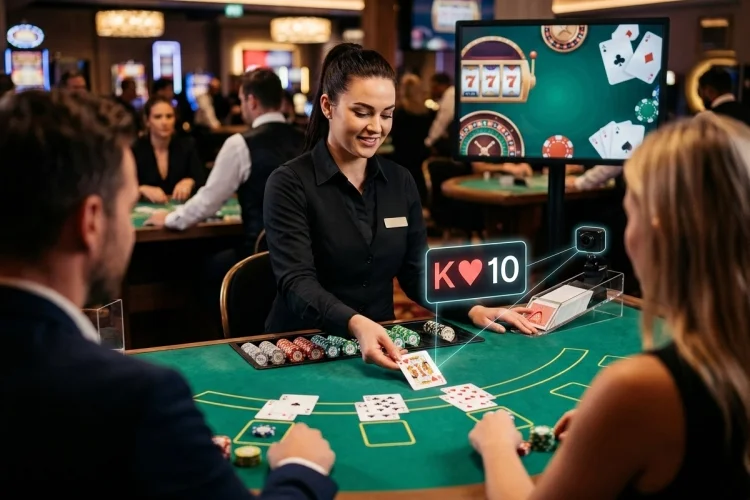
A live casino stream does more than show a dealer on camera. Behind the video, software must understand what is happening on the physical table so bets, hand totals, game history, and results can appear correctly on the player’s screen.
So, What Is Optical Character Recognition in this environment? OCR is a form of visual data extraction that turns characters and symbols captured in images into information a computer can process.
When adapted to live gaming, it can form part of the system that connects real cards and physical results with an interactive digital interface.
OCR Turns Visual Information Into Data
At its core, OCR is a recognition technology.
A camera or scanner captures an image containing visual information. Software analyses that image and tries to identify relevant letters, numbers, or other characters.
Once recognised, those visual elements are converted into structured digital information.
AWS describes OCR as the electronic or mechanical conversion of images containing text into machine-encoded text. More advanced machine-learning systems can also detect layouts and other structured information.
In a live casino context, the same general principle can be adapted for specialized gaming inputs.
Instead of scanning an invoice, the system may need to interpret a card rank or another visible element from the table.
That information can then become part of the live game’s data stream.
The Live Casino Has Two Streams to Synchronize
A live dealer game effectively has a visual stream and a data stream.
The visual stream is what players watch: the dealer, cards, table, wheel, and studio.
The data stream contains machine-readable events.
For example, the software may need to know that the dealer revealed a 10, that the player currently has 18, or that the roulette round ended on a certain pocket.
BetMGM explains that its live blackjack experience uses multiple cameras, table sensors, and OCR tools so physical card information can be captured and reflected in the player’s interface.
These two streams need to remain closely matched.
Seeing one card on video while the digital display shows another would create an obvious problem.
That is why recognition, transmission, and verificaton need to work together.
A Simple Live Blackjack OCR Pipeline
Consider what happens when the dealer draws a card.
First, the physical card enters a position where the camera or recognition equipment can see it.
The image is captured.
The recognition software analyses the relevant visual pattern and identifies the card information. That output is converted into digital data and forwarded to the gaming system.
The platform can then update the player’s hand.
If the player moves from 11 to 21, for example, the interface can immediately reflect that total.
At the end of the hand, the betting system can use the confirmed physical result according to the game’s rules.
This process looks instantaneous to the player, but several seperate technical steps occur between the physical table and screen.
The workflow resembles general OCR pipelines described by IBM, which include image acquisition, preprocessing, character recognition, and digital output.
OCR Works Alongside Other Hardware
The phrase “OCR technology” can create the impression that one camera does everything.
Real systems can be more complicated.
Live casino studios may combine image recognition with table sensors, specialized card equipment, wheel sensors, server-side software, and other tracking technology.
The combination depends on the provider and game.
Roulette, for example, presents a different recognition problem from blackjack. A blackjack system focuses heavily on cards, whereas a roulette system must reliably identify the winning pocket.
The important concept is redundancy and accurate result capture, not whether one specific technology handles every part of the process.
This is why it is safer to say OCR is a component of some live casino systems rather than claiming every result everywhere is recorded solely by OCR.
What Is the Game Control Layer?
Once recognition software identifies the physical event, another system must connect it with the digital game.
Industry descriptions often refer to a Game Control Unit or related game-control infrastructure.
Its practical role is to help coordinate information from the physical table with the online platform.
The game system may receive the recognised result, connect it with active bets, update player displays, and record the event in game history.
Meanwhile, the video continues streaming.
Evolution’s description of live casino development highlights how the category grew from simple webcam broadcasts into interactive systems combining stable video, software, real-time controls, and physical casino action.
The recognition layer is one reason a live casino can behave like an interactive application rather than an ordinary livestream.
Why Automatic Recognition Is Useful
Imagine a dealer having to stop after every card and type the result manually.
Blackjack would become slower, and data-entry mistakes would become another operational risk.
Automated recognition can reduce that manual step.
It allows the physical action to be captured while the dealer continues running the table.
That can support automatic hand totals, winning-result displays, statistics, and electronic settlement.
It can also help scale a game to many online participants watching the same physical table.
The technology does not eliminate the need for trained staff.
Live casino operations still rely on dealers, supervisors, technical personnel, and monitoring systems.
The UK Gambling Commission requires live dealer operations within its scope to be supervised, fair, and independently auditable.
Automation and human oversight therefore work together rather than replacing each other entirely.
Recognition Accuracy Depends on Image Quality
OCR performance depends heavily on what the system can see.
A card shown at a poor angle or under problematic lighting is harder to recognise than one presented clearly.
General OCR systems face similar issues.
IBM notes that low resolution, poor lighting, loss of focus, misalignment, and visual artifacts can create recognition challenges.
Live casino studios can reduce these problems by controlling the environment.
Lighting can remain consistent. Cameras can stay fixed at tested angles. Cards and gaming equipment can follow standardized procedures.
These conditions are generally much more predictable than somebody photographing a crumpled receipt with a phone.
A controlled environment can therefore make specialised recognition considerably more managable.
OCR Is Not the Same as Artificial Intelligence
OCR and AI are related in some modern systems, but the terms are not interchangeable.
Traditional OCR can rely on pattern matching and predefined visual features.
More advanced recognition systems may use machine learning or neural networks to improve how they interpret difficult images.
IBM distinguishes traditional pattern recognition from more sophisticated intelligent character recognition techniques that use AI and machine learning.
In a live casino article, it is therefore inaccurate to automatically describe every OCR camera as “AI.”
The exact technology depends on the provider.
The useful point is that the software interprets visual information and converts it into structured data that other casino systems can process.
Does OCR Affect the Randomness of the Game?
OCR records information; it does not normally create the physical outcome it is reading.
When a dealer draws a physical card, the recognition system identifies that card after or as it is exposed.
When a physical roulette wheel determines an outcome, recognition or sensor systems can record the result.
The difference matters.
Players sometimes confuse result recognition with result generation.
A camera recognising a roulette number does not imply that the camera chose the number.
For live dealer operations in Great Britain, the Gambling Commission requires the underlying operation to be fair and auditable, with commercial-quality equipment, trained dealers, surveillance, and game logs.
Those operational safeguards exist separately from the recognition algorithm itself.
OCR Data Also Supports Game Records
Live casino results need to do more than appear briefly on the screen.
Operators may need game history and event records for operational monitoring, auditing, and dispute handling.
The UK Gambling Commission’s live dealer guidance says game logs should be maintained and events collated into statistics that can be analysed for trends in game performance, staff, or gaming areas.
Automated result capture can help feed this broader record-keeping infrastructure.
If a player disputes a hand, an operator may have multiple forms of evidence available, including video surveillance and electronic game records.
OCR should therefore be understood as part of a larger information chain rather than an isolated feature sitting inside the camera.
Latency Can Still Affect the Player’s Screen
Even if the recognition happens quickly, the result still has to travel through network infrastructure.
The system needs to process the event, update servers, synchronize the game interface, and send information to the player’s device.
The video itself must also travel across the internet.
This can introduce delay.
The UK Gambling Commission’s time-critical-event standards require operators to consider network latency and device performance when those factors could disadvantage customers.
A delayed display does not necessarily mean OCR failed.
The recognition could have happened correctly at the studio while the player’s network connection delivered the updated interface more slowly.
That distinction is easy to miss because all of these processes happen behind one visible screen.
OCR Is Only One Part of Live Casino Technology
A complete live casino requires far more than character recognition.
It also needs cameras, microphones, studio lighting, streaming infrastructure, betting software, servers, dealer interfaces, security systems, surveillance, and physical gaming equipment.
Evolution’s current description of the sector shows how live casino has developed from simple streamed tables into a large interactive broadcasting category.
OCR sits somewhere in the middle of that system.
It helps the digital platform understand physical information, but it does not replace the dealer, determine every outcome, or guarantee the entire operation by itself.
That wider context is important when explaining the technology accurately.
Optical Character Recognition can help live casino software turn visible information from real cards and table events into digital data. That data can support hand totals, game history, interface updates, and result processing.
OCR works alongside cameras, sensors, game-control systems, servers, surveillance, and trained staff. Understanding that larger pipeline makes the technology behind a live dealer table much easier to appreciate.
